

Horizon at Cow Bay 2026: 2 days, Seven Races, Too Much Fun
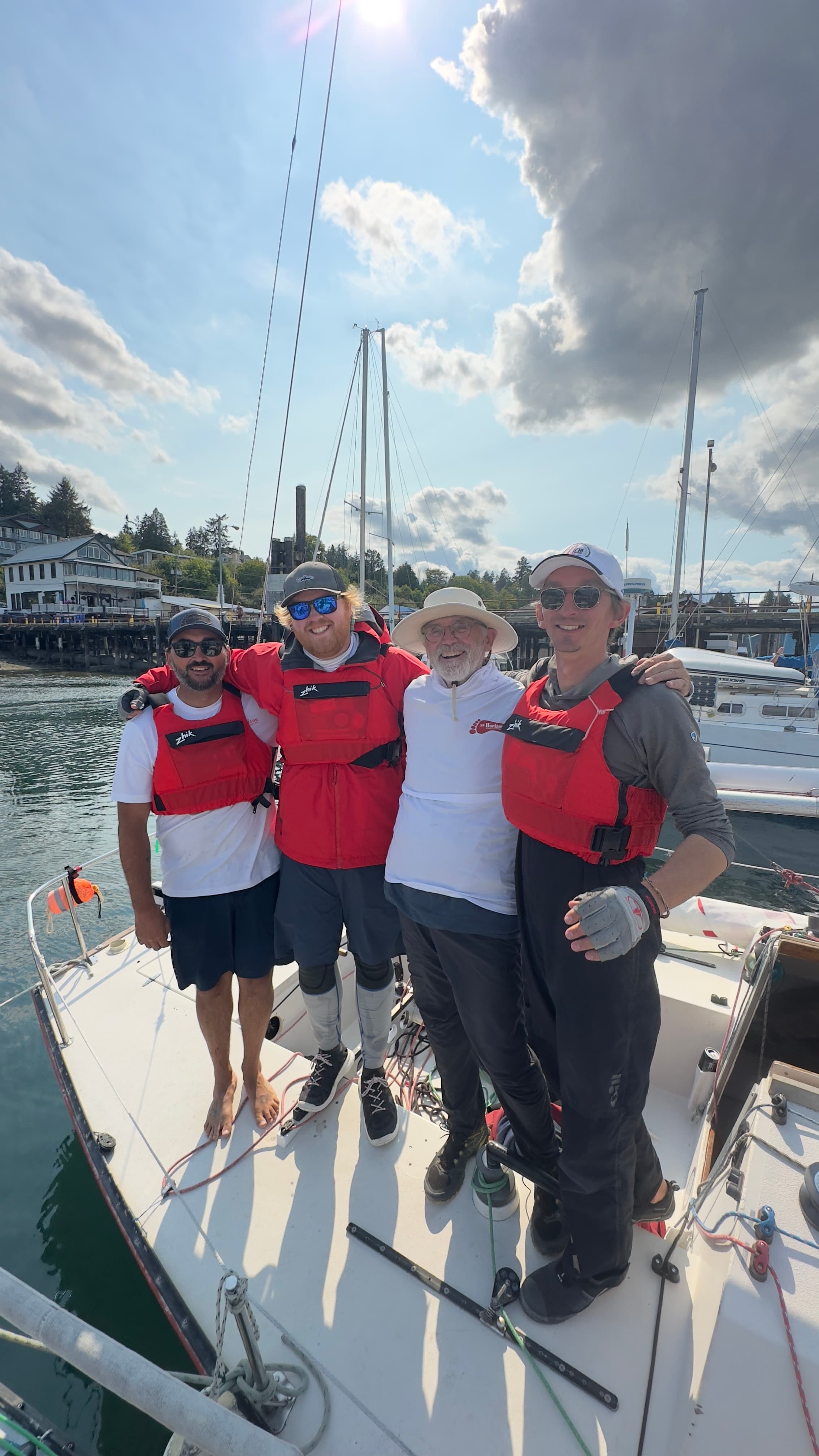
Cow Bay was Horizon’s first regatta away from home and our first chance to line up against other Hotfoot 27s. After two days and seven races in PHRF Division 4, we came away with second place, plenty of confidence in the boat—and a reasonably urgent list of things to learn about sailing downwind.
Saturday: Four Races and the Breeze Out of the Bay
Saturday began with a forecast that looked fairly gentle. By the time we reached the course it was blowing around 12 knots, by the time the main was up it was closer to 15, and shortly afterward we were seeing gusts over 20. The breeze was blowing out of the bay, tumbling off the hills from the west and southwest and producing huge shifts and occasional bomb puffs capable of auto-tacking the boat.
As a first-time Cow Bay sailor, I was informed during the opening race that sailing into the bay on the upwind leg was “the wrong way.” Naturally, when Sunday brought the more usual course orientation, it felt backward compared with everything I had learned about Cow Bay.
Saturday’s starts were the strange ones. With the upwind leg running into the bay, the committee boat was on the left side of the line—the opposite of what we were used to seeing in a normal windward-leeward. The fleet would come in on starboard, nearly parallel to the line, trying to win that end before tacking onto port as quickly as possible and heading up the course. With the line heavily skewed, we were effectively coming off it on port at almost a 90-degree angle. We responded with two—and possibly three—fairly terrible starts. Fortunately, Horizon had enough upwind speed to claw her way back into the race each time.
We had arrived excited to use our brand-new genoa. Instead, Saturday’s conditions gave us the opportunity to use our “brand-new” two-year-old jib, which had barely seen daylight. It turned out to be fast.
Communication along the rail was excellent. We called and counted down the puffs, tried to predict whether each one would lift or knock us, and watched some shifts swing through 15 or 20 degrees. Meanwhile, our skipper drove and worked the main relentlessly, displaying the relaxed manner of a man trying to prevent a 27-foot sailboat from launching itself into the next municipality.
With no runners and the backstay nearly maxed out, Horizon felt genuinely quick upwind. The only slightly alarming part came when the main was eased and flogging and the entire rig started rattling around. Swept-back spreaders are already on next year’s list.
The first two races confirmed that boatspeed wasn’t going to be our problem. The fleet included ratings from Horizon’s 141 through 168 and 178—a 37-second spread that can make a short buoy race difficult to read. We mostly concentrated on NVS and Pauhana, the other Hotfoot 27s, and on keeping NVS behind us whenever possible.
One race featured a tight reaching leg. We carried the kite for most of it before changing down to the genoa approaching the leeward mark. Another was a proper windward-leeward, complete with an upwind finish—one of Cow Bay’s best features. There is nothing quite like finishing at the end of a final beat with the boats still close enough for every tack and crossing to matter.
In one of Saturday’s best moments, we approached the final mark inside NVS, came in too tight, rounded wide, then used the extra room to come out tight inside them. From there we held them off cleanly to the finish. After spending much of the day regarding the downwind legs with mild suspicion, beating another Hotfoot in a close final beat felt especially satisfying.
Starting and racing alongside the Moore 24s made the whole weekend better. Although their rating is quite different, their actual performance was remarkably similar to the Hotfoots—helped, no doubt, by how well they are sailed. They created more starts, crossings and tactical decisions, and made a mixed PHRF fleet feel much more like a 15-boat one-design race. They also made excellent pace cars.
Sunday: Three Races and the Usual Way Around
The second day of racing brought lighter air and some confusion about the time-on-time results after the scoring software appeared to have explored a more creative branch of mathematics. We weren’t entirely sure where everyone stood, but we knew Horizon was fighting for a podium and needed another clean day.
The conditions looked familiar. We normally sail in Ganges Harbour, where the breeze is light, fickle and puffy, so we felt at home. The committee boat was also back on the normal side of the line, and the starts felt much more like classic dinghy starts, with everyone fighting to win the boat end. We managed what felt like three solid starts—a welcome change after Saturday.
Sunday’s strategy was the classic Cow Bay strategy: get into shore and stay there on the upwind leg. Hugging the shoreline appeared faster most of the time. The exception came when a few boats starting near the pin were either smarter than the rest of us or lucky enough to find breeze farther out that carried them straight up the course while we messed around against the beach.
Horizon was again extremely fast upwind and reached the top mark first in our division several times.
Then we turned downwind.
Despite sailing hotter angles and heading up whenever the clew began to sag, we watched the fleet steadily reel us back in. We now have a winter project: determine how much of that came from the spinnaker and how much was, in the modern technical terminology, a skill issue.
For much of Sunday, the Hotfoots settled into a predictable order: NVS first, Horizon second and Pauhana third. Going into Race 7—the third and final race on Sunday—we believed there was still a chance to win the regatta if we could beat NVS, particularly if we could put another boat between us.
We had a good start and wanted to tack onto port immediately to get inshore. We saw a small lane and decided it was ours. It was not. We were already a little too close, and some distraction during the tack meant we did not power the boat up quickly enough. While we were looking around trying to determine which boat we were about to foul, we fouled Dopamine, who quite reasonably protested us.
We did our circle, got Horizon moving again and still sailed the race we had intended. We found clean air inshore, caught Dopamine again by the next tack and continued putting distance between us and the other boats we had let past. Despite the spin at the start, we were the second or third boat in the fleet to reach the top mark.
Then we got our asses handed to us downwind. Everyone reeled us in. A fresh breeze arrived from behind and compressed the fleet, erasing much of the work we had done on the beat. By the leeward mark, NVS was about 20 boat lengths ahead rounding with a half dozen Moores. It turns out if we had been closer to him we might have noticed that it wasn't the cleanest mark rounding ever, but we were focused on our boat and rounding plan at that point (genny up on starboard, burry the pole early, gybe and a clean takedown to windward).
With one beat remaining, we decided subtlety had run its course and went into full match-racing mode.
We tacked back and forth perhaps 12 or 15 times on the beat to the finish. For the first ten, Horizon gained roughly half a boat length on every exchange. It was working—until we let several Martins get between us and slow the chase. Once NVS reached the layline, they extended, while the higher-rated boats caught up do to our private tactical seminar. We crossed with a fourth, turning an ambitious attempt to win the regatta into a useful demonstration of how to throw away a perfectly respectable finish. Maybe also a good reminder that if you are scratch boat in a handicap fleet, the boats behind you matter too.
Horizon ended the weekend second overall, which felt like the right result. NVS beat us more often than we beat them and deserved the win. But we came home fired up by Horizon’s speed, the competitiveness of the Hotfoot 27 fleet and the possibilities for next year (when we definitely will for sure without question have a Hotfoot 27 one design fleet).
More than anything, Cow Bay was a reminder of how much fun racing becomes when affordable boats are gathered into competitive groups. With the Hotfoot 27s and Moore 24s together, it felt less like a scattered handicap fleet and more like proper one-design racing.
We need more of that: cost-effective boats, close fleets and enough similar competition that every start, rounding, crossing and finish matters.
We’ll be back next year—hopefully with swept-back spreaders, faster downwind technique (and maybe a new chute) and perhaps slightly fewer tacks before the finish on the last race.